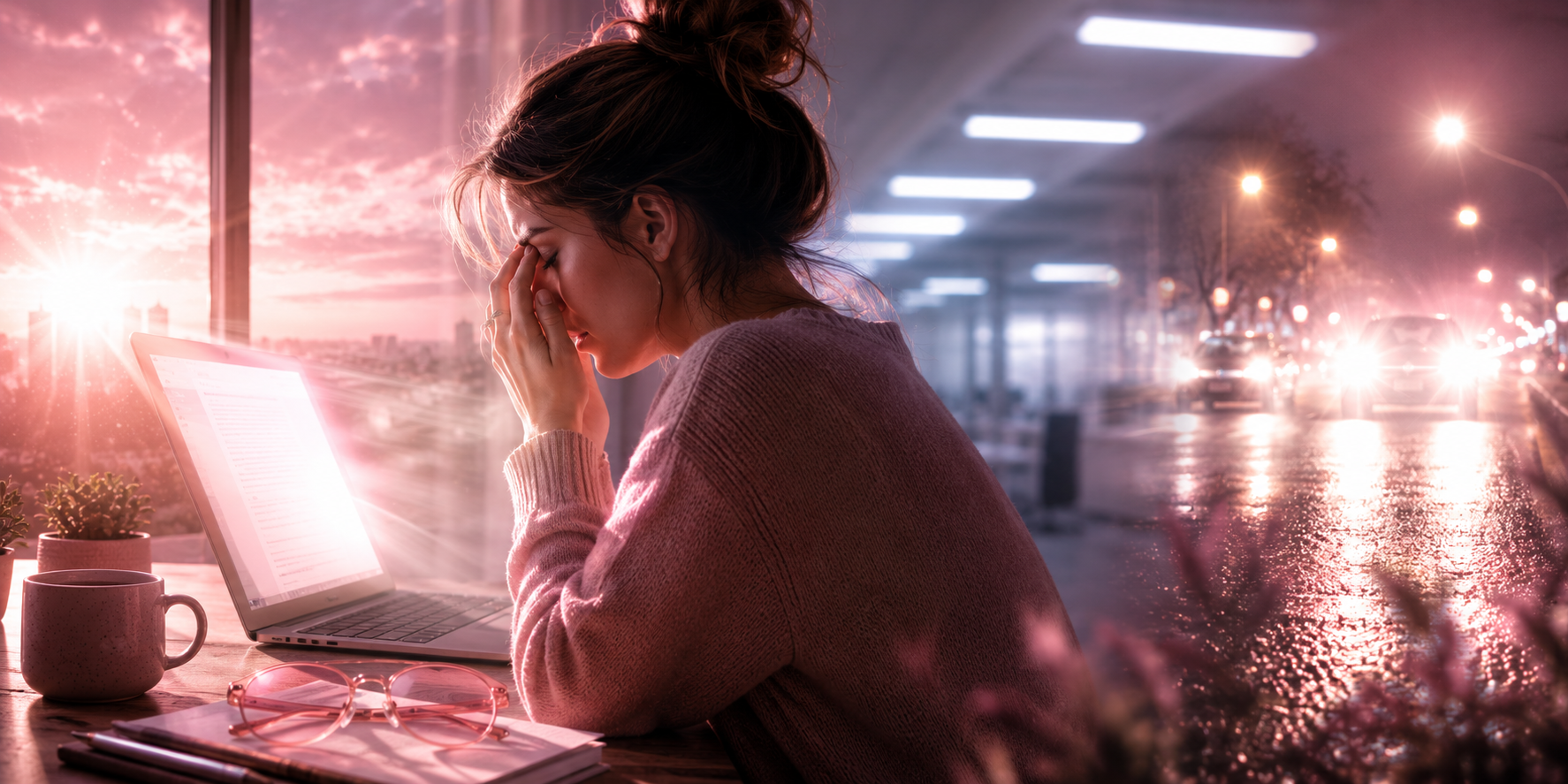
WHEN LIGHT
FEELS TOO
MUCH.
A practical guide to light sensitivity, photophobia and light-related sensory overload — including screens, fluorescent lights, supermarket dizziness and glare.
If you’re autistic, have ADHD or are otherwise neurodivergent, and light feels uncomfortable or overwhelming, this guide is for you too. You don’t need migraines to explore ways to support your sensory comfort.
Understand your everyday triggers, explore practical adjustments and learn where FL-41 lenses may help.
IN THIS GUIDE
- Light sensitivity — with or without migraine
- Neurodivergence and light-related sensory overload
- Screens, LEDs and fluorescent lighting
- Supermarkets, glare and visual overwhelm
- Practical adjustments and where FL-41 may help
Light Sensitivity: Symptoms, Causes and Why Everyday Environments Can Feel So Difficult
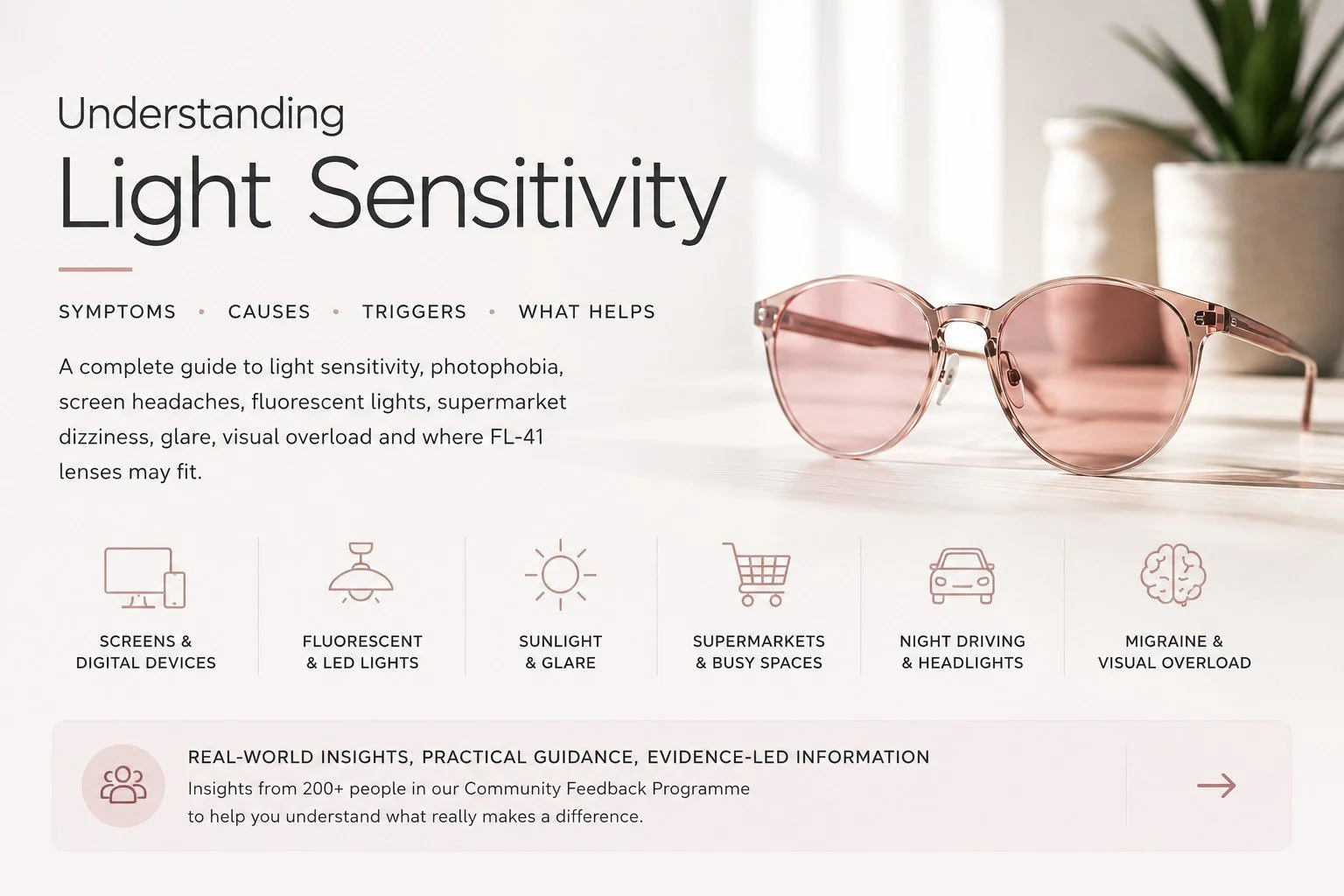
A complete, plain-English guide to light sensitivity, photophobia, screen headaches, fluorescent lights, supermarket dizziness, glare, visual overload and where FL-41 lenses may fit.
Light sensitivity or sensory overload? This guide is for you too. Some autistic people, people with ADHD and other neurodivergent people find bright lighting, glare, screens or visually busy spaces uncomfortable or overwhelming. You don’t need to experience migraines to explore support for light-related comfort.
Start with the summaries, then open any section for the fuller explanation.
Show guide contents
Common symptoms of light sensitivity
Light sensitivity can show up in the eyes, the head, the body and day-to-day behaviour. These are the patterns people most often describe.
Eye symptoms
- Squinting in bright light
- Eye strain or aching eyes
- Glare discomfort
- Watery or irritated eyes
- Difficulty with white screens
Head and body symptoms
- Headaches after screens or bright places
- Migraine symptoms
- Nausea or dizziness
- Fatigue after shopping or working
- Feeling visually overwhelmed
Everyday triggers
- Fluorescent lighting
- LED lights
- Computer screens
- Supermarkets and shopping centres
- Headlights and glare
What is light sensitivity?
Light sensitivity means light causes discomfort or feels difficult to tolerate. It may show up as eye strain, headaches, dizziness, nausea, fatigue, visual overwhelm or pain around screens, lighting, glare, supermarkets, headlights or bright white backgrounds.
Read the detailed explanation
Light sensitivity, sometimes called photophobia, is more than simply finding bright sunlight uncomfortable. Light may cause discomfort, eye strain, headaches, dizziness, visual overwhelm or pain in situations that other people barely notice. If that sounds familiar, you are not imagining it, and you are not alone. For some people it happens only now and then. For others it becomes a daily issue that affects work, travel, shopping, driving and screen use.
That is part of what makes light sensitivity so hard to explain. A room, office or shop can look completely normal, while being in it feels exhausting. Screens may feel harsh, supermarket lighting can become overwhelming, headlights may seem painfully bright, and ordinary indoor lighting can trigger headaches, fatigue, nausea or that familiar sense that the visual world is becoming too much. Many people struggle for a long time before they realise this is a recognised issue rather than something they just have to “put up with”.
In practice, it often shows up around computer screens, fluorescent lights, LED lighting, supermarket aisles, bright white webpages, oncoming headlights, reflective floors and sharp glare from windows or polished surfaces. Some people notice it most when they are tired, stressed or run down. Others find symptoms build across the day until they suddenly need to stop, rest or leave the environment.
Many people describe light sensitivity in different ways
- Bright lights hurt my eyes
- Screens make me feel exhausted
- Supermarkets make me feel dizzy
- White backgrounds feel uncomfortable
- LED lights seem too harsh
- I feel overwhelmed in brightly lit places
Although these experiences may sound very different, they can be part of the same broader picture.
Light sensitivity is a symptom rather than a diagnosis. It describes discomfort in response to light, but it does not automatically tell you why. That is one reason two people can describe almost identical struggles with screens, glare or supermarkets while having very different underlying causes. One person may have migraine, another may have dry eye, another may be recovering from concussion, and another may experience sensory differences that make particular environments overwhelming.
This matters because many people spend a long time searching for the “right label” while their day-to-day problems keep getting worse. Work feels harder, shopping becomes draining, night driving feels stressful, or bright places suddenly seem much less tolerable than they used to. If that is where you are right now, a helpful starting point is to notice patterns: which lights are worst, which environments bring symptoms on fastest, and whether the problem feels more like pain, eye strain, dizziness, nausea, fatigue, blur or overwhelm.
Light sensitivity can occur with eye conditions, migraine, other health conditions or sensory differences. Dry eye and tear-film problems can also contribute to glare and discomfort. It is not limited to one single diagnosis.
One reason light sensitivity can be frustrating is that many people are told their eyes appear healthy during routine examinations. That does not make the symptoms less real, and it does not mean you have to ignore them. Persistent symptoms may need further assessment.
Understanding your triggers is often the first step towards finding practical ways to support comfort.
A helpful starting point is to think about three things: what types of light bother you most, which environments trigger symptoms fastest, and what other symptoms tend to appear at the same time. Some people mainly react to brightness, while others are more affected by flicker, glare, contrast, motion, visual clutter or long periods of concentration. Understanding those patterns can make it much easier to find practical adjustments that help.
Why screens, supermarkets and bright indoor lights can feel so difficult
Modern environments often combine brightness, glare, flicker, reflections, movement, visual clutter and concentration. The problem is not always one light source — it is often the total visual load.
Read the detailed explanation
Many people assume light sensitivity is simply a reaction to brightness. In reality, brightness is often only one part of the problem. Two environments can look equally bright on paper, yet one may feel manageable while the other feels unbearable. That is because the visual system is not only responding to light intensity. It is also responding to glare, contrast, flicker, reflections, movement, colour temperature, visual clutter and how much concentration is required to make sense of the scene.
Modern environments often combine several visual stressors at once. A supermarket may include fluorescent or LED lighting, reflective floors, bright packaging, busy shelving and movement in your peripheral vision. An office may combine overhead lights, window glare, bright screens and long periods of concentration. Even a phone screen can become difficult if it is very bright and used for hours without a break. When all of these demands stack together, the result can feel like visual overload rather than a simple dislike of bright light.
This helps explain why some people feel fine outdoors on an overcast day but struggle as soon as they enter a brightly lit shop, or why they can cope with a screen for a short time but feel increasingly unwell after several hours of work. It is not always the amount of light alone that matters. It is often the combination of brightness, contrast, glare, flicker, movement and mental effort that makes an environment difficult to tolerate.
Common experiences include
- Headaches after using screens
- Feeling tired after shopping
- Difficulty concentrating under fluorescent lighting
- Eye strain during computer work
- Dizziness in visually busy environments
- Needing to leave brightly lit places earlier than other people
- Increased sensitivity after long periods of visual effort
Many people who experience these symptoms do not initially associate them with light sensitivity. They may believe they simply dislike supermarkets, struggle with office environments or become tired more easily than others.
Real-world feedback suggests that fluorescent lighting, screens and glare are among the commonly reported triggers for people dealing with light sensitivity and related symptoms. While this is not the same as clinical proof, it reflects environments that come up repeatedly in people’s everyday experiences.
If light sensitivity is new, severe, painful, or linked with changes in vision or a very red eye, it is worth ruling out an eye condition or another medical cause rather than assuming it is simply an environmental issue.
Light sensitivity without migraine
Migraine is one of the best-known links, but light sensitivity can happen without migraine. Dry eye, visual stress, concussion, vestibular issues, sensory processing differences and other causes can all be involved.
Read the detailed explanation
One of the biggest misconceptions surrounding light sensitivity is that it only affects people who experience migraine.
Migraine is certainly one of the conditions associated with light sensitivity, but it is far from the only one.
Many people experience significant discomfort from light without ever describing themselves as someone with migraine. Some notice symptoms primarily when working on screens. Others struggle in supermarkets, shopping centres or brightly lit workplaces. Some become particularly sensitive following illness, concussion or periods of stress.
Light sensitivity may occur alongside
- Photophobia
- Visual stress
- Dry eye
- Vestibular migraine
- Sensory processing differences
- Autistic sensory experiences
- ADHD
- Concussion or head injury
- Post-viral symptoms
- Certain neurological conditions
- Eye health problems
The important point is that light sensitivity itself is a genuine experience regardless of the underlying cause.
Two people may have completely different diagnoses yet describe remarkably similar daily challenges. Both may struggle with screens. Both may find fluorescent lighting uncomfortable. Both may avoid certain environments because of glare, visual overload or discomfort.
You do not need migraines, or an autism or ADHD diagnosis, to ask about light-related comfort. Identifying your triggers and checking possible medical causes can help you explore appropriate support.
Light sensitivity is best thought of as a symptom that may have many possible causes. The fact that migraine is absent does not make the experience any less genuine or significant.
What is photophobia?
Photophobia is the medical term for light sensitivity. It does not mean fear of light; it means light causes discomfort, pain or reduced tolerance.
Read the detailed explanation
Photophobia is the medical term used to describe light sensitivity. Despite the name, it does not mean a fear of light. Instead, it refers to discomfort, pain or unusual sensitivity when exposed to certain types of light.
People with photophobia often describe experiences such as
- Bright lights hurting their eyes
- Needing sunglasses more often than others
- Headaches triggered by screens
- Difficulty coping with fluorescent lighting
- Eye strain in offices or supermarkets
- Feeling overwhelmed in bright environments
Photophobia is not a condition in itself. It is a symptom that can show up in many different situations, including migraine, vestibular migraine, dry eye, concussion, visual stress, sensory processing differences and certain eye health problems. The word does not identify the cause or severity on its own. Light-triggered discomfort deserves to be taken seriously and understood properly.
Photophobia is a common and often disabling feature of migraine, and bright stores, screens, glare and visually busy places can also worsen dizziness, nausea and visual discomfort in people with vestibular-related light sensitivity. One person may mainly experience pain from brightness, while another mainly struggles with screens, supermarkets, scrolling, headlights or visual motion.
People often use everyday wording long before they hear the term photophobia. They may say they cannot cope with white screens, need sunglasses more than everyone else, find supermarkets unbearable, or feel wiped out after a day in artificial lighting. Those descriptions still matter.
One reason photophobia can be frustrating is that symptoms vary enormously between individuals. Some people struggle only in bright sunlight, while others find indoor lighting, screens or vehicle headlights far more problematic.
Research and real-world experiences suggest that light sensitivity is not always related to brightness alone. Colour temperature, glare, flicker, contrast and the amount of visual information being processed can all play a role.
If light sensitivity is new, severe, painful or accompanied by changes in vision, it is important to seek professional advice. An optician or healthcare professional can help rule out underlying eye health concerns and identify whether further investigation is needed.
For many people, understanding that photophobia is a recognised symptom can be reassuring. It provides a framework for understanding why everyday environments may feel far more visually demanding than they do for other people.
Why fluorescent and LED lights can feel so harsh
Artificial lighting can feel difficult because of glare, flicker, brightness, contrast, colour temperature, reflections and overhead positioning. This is why offices, schools, shops and hospitals can be harder than expected.
Read the detailed explanation
One of the most common complaints among people with light sensitivity is difficulty coping with artificial lighting.
Offices, schools, supermarkets, hospitals, shopping centres and workplaces often rely heavily on fluorescent or LED lighting. While these environments may feel perfectly comfortable for some people, others experience headaches, eye strain, fatigue, dizziness or visual discomfort within minutes of exposure.
People often describe fluorescent and LED lighting as
- Harsh
- Clinical
- Overwhelming
- Tiring
- Too bright
- Difficult to ignore
The problem is not always simple brightness. Artificial lighting can feel difficult because of glare, contrast, colour temperature, flicker, reflections and the way the light is distributed across a room. Some environments feel especially tiring because the lighting is bright from above, reflects off hard surfaces and offers very little visual relief.
Glare can reduce visual comfort and sometimes reduce how well a person sees. Discomfort glare feels unpleasant, while disability glare interferes with vision. That distinction helps explain why some people say certain lights are painful while others say they feel washed out, dazzled, visually confused or slower to recover after exposure.
This is why two offices with the same overall brightness can feel completely different. A space with softer lighting, fewer reflections and better screen positioning may feel manageable, while another with direct overhead LEDs, glossy desks and bright white walls may feel exhausting within minutes.
Many people notice that they can tolerate natural daylight more comfortably than artificial lighting, even when daylight is technically brighter. The quality and characteristics of light can sometimes matter more than simple light intensity.
Real-world feedback also identifies fluorescent lighting, screens and glare as recurring triggers. These patterns do not prove cause and effect, but they show how often artificial lighting appears in the experiences of people seeking help for light sensitivity.
For people who spend long hours under artificial lighting, small changes can sometimes make a meaningful difference. Reducing glare, adjusting screen brightness, taking regular visual breaks and exploring specialist lens options may help improve comfort depending on individual needs and the underlying cause.
Why supermarkets can make you feel dizzy, overwhelmed or exhausted
Supermarkets combine bright overhead lighting, long aisles, reflective floors, movement, noise, crowds and busy shelves. For some people this creates visual overload, dizziness, fatigue, nausea or headaches.
Read the detailed explanation
This is one of the common questions discussed in migraine, vestibular migraine, sensory processing and light sensitivity communities.
Many people notice that supermarkets feel strangely different from other environments. They may enter feeling fine but leave with a headache, dizziness, fatigue, nausea or an overwhelming desire to get out as quickly as possible.
Supermarkets combine many visual challenges in a single environment
- Bright overhead lighting
- Long aisles
- Reflective floors
- Large amounts of visual information
- Constant movement
- Crowds
- Noise
- Bright packaging and signage
Long aisles create strong visual perspective, reflective floors bounce light back upwards, bright packaging competes for attention, and other shoppers add movement in every direction. If you are sensitive to light, motion, pattern or glare, that kind of environment can become draining quickly.
This experience is sometimes described as visually induced dizziness or “supermarket syndrome”. Grocery stores combine bright lights, shelves, patterns, crowds and constant visual scanning. For some people, the result is dizziness, nausea and light-headedness.
The problem is not a personal weakness or a failure to cope. An environment can place demands on your sensory, visual or balance systems that feel difficult to manage. Useful patterns may include which store layouts are worst, whether quieter times help, or whether glare and busy flooring are bigger triggers than brightness alone.
People commonly report
- Feeling dizzy in supermarkets
- Needing to focus on the floor while walking
- Becoming anxious in brightly lit stores
- Feeling exhausted after shopping
- Headaches during or after visits
- Difficulty concentrating in busy environments
These experiences can occur alongside migraine, vestibular migraine, photophobia, sensory processing differences, post-concussion symptoms and other forms of visual sensitivity.
Understanding personal triggers can be helpful. Some people benefit from visiting at quieter times, wearing a hat to reduce overhead glare, limiting time in visually intense environments or exploring lenses for light-related discomfort.
Persistent dizziness, faintness or new symptoms should be assessed rather than automatically attributed to lighting or sensory overload.
Why screens trigger headaches, eye strain and light sensitivity
Screens combine brightness, glare, high contrast, white backgrounds, close focus, reduced blinking and long concentration. That makes them one of the biggest daily triggers for many light-sensitive people.
Read the detailed explanation
Modern life revolves around screens. Whether we are working, studying, gaming, shopping or socialising, many of us spend hours each day looking at phones, tablets, laptops and computer monitors.
For people with light sensitivity, screens can be one of the most challenging visual environments of all.
Screens combine several potential triggers at the same time
- Brightness
- Glare
- High contrast
- White backgrounds
- Continuous visual focus
- Reduced blinking
- Long periods of concentration
Many people describe symptoms such as
- Headaches after screen use
- Tired or aching eyes
- Difficulty concentrating
- Sensitivity to white backgrounds
- Increased migraine symptoms
- Feeling mentally drained after computer work
Screen discomfort is not always caused by needing a stronger prescription. Screens place sustained demand on the visual system. They encourage continuous near focus, reduce blinking, expose the eyes to glare and contrast for long periods, and often involve hours of concentration without enough recovery time. For people who experience migraine, dry eye, photophobia or visual overload, that can contribute to headaches, eye strain, nausea or mental fatigue.
Screen discomfort often involves a combination of light sensitivity, visual demand and surface eye irritation rather than one single cause. Prolonged screen use can worsen dry-eye symptoms through reduced blinking.
Feedback from people dealing with light sensitivity also identifies screens as a recurring day-to-day trigger.
Many people find relief by combining several approaches rather than relying on a single solution. Lowering brightness, reducing glare, taking regular visual breaks, using larger text and ensuring an up-to-date prescription can help reduce visual effort throughout the day.
For some individuals, managing screen-related discomfort becomes an important step in reducing overall symptom load because screens represent a large daily source of visual demand.
Why white screens and bright backgrounds can hurt your eyes
Bright white backgrounds create high brightness and high contrast at the same time. Some people find dark mode easier, while others prefer softer off-white, cream or warm-toned backgrounds.
Read the detailed explanation
Bright white backgrounds can be difficult because they create high brightness and high contrast at the same time. A white document, webpage or spreadsheet may not look dramatic, but after long periods it can become one of the biggest daily triggers for people with light sensitivity.
Some people find dark mode easier. Others prefer softer cream, grey or warm-toned backgrounds rather than a fully dark screen. The best option is usually the one that reduces glare and contrast without making text harder to read.
Why headlights feel so bright at night
Night driving can become difficult because the eyes constantly adapt between dark roads and intense headlight glare. Wet roads, reflective signs and modern LED headlights can make the problem worse.
Read the detailed explanation
Many people who cope reasonably well during the day find night driving far more difficult.
Many drivers report discomfort when facing LED headlights, reflections from wet roads and high levels of glare.
Common complaints include
- Oncoming headlights feel blinding
- Difficulty recovering after bright lights pass
- Eye strain during night driving
- Increased headaches after driving
- Reduced confidence on dark roads
- Difficulty seeing road markings after glare exposure
Part of the challenge comes from contrast. At night, the eyes are adapting to a much darker environment. When a bright light source appears, the visual system must adjust between dark and bright conditions.
For people with light sensitivity, migraine, photophobia or glare sensitivity, this adjustment process may feel much more demanding.
The problem is not limited to the headlights themselves. Wet roads, reflective signs, dashboard lighting and bright street lighting can contribute to visual fatigue during longer journeys.
Night driving difficulties can form part of a wider pattern of light sensitivity that includes screens, glare and brightly lit indoor environments. Changes in prescription, dry eye and eye conditions can also contribute.
Get worsening night vision or glare assessed. Do not assume tinted lenses are suitable for night driving: suitability depends on the specific finished lenses and the relevant driving requirements.
What visual overload actually feels like
Visual overload describes an experience of visual information feeling too much to comfortably process. Light-related sensory overload may be part of this, alongside movement, patterns, crowds or visual clutter.
Read the detailed explanation
Visual overload describes what it feels like when visual information becomes overwhelming. Some people experience this after time in a crowded shopping centre, busy airport or large event. For others, it happens more readily or intensely.
People often describe visual overload as
- Feeling overwhelmed in busy environments
- Difficulty focusing on one thing
- Needing to leave crowded spaces
- Feeling mentally exhausted after shopping
- Difficulty processing movement around them
- Increased dizziness or headaches
- Feeling more comfortable in quieter environments
Visual overload is not necessarily caused by brightness alone.
Instead, it may involve a combination of
- Lighting
- Movement
- Patterns
- Crowds
- Colour contrasts
- Glare
- Visual clutter
This is why supermarkets, shopping centres and large open-plan offices appear frequently in discussions about light sensitivity.
Light sensitivity and sensory overload are related, but different
Sensory overload can involve sound, touch, smells and other inputs as well as vision. Light sensitivity can be one part of that experience. Making light more comfortable may support you in a particular environment, but it will not necessarily address every source of overload.
Some autistic people, people with ADHD and other neurodivergent people experience light-related sensory overload. Others do not. The aim is to recognise your sensory needs and find useful support, rather than expect you to push through an uncomfortable environment.
Visual overload can also occur alongside migraine, vestibular migraine, photophobia, concussion recovery and chronic light sensitivity.
Understanding these experiences can help explain why an environment feels exhausting even when eyesight appears clear. New or worsening symptoms still deserve appropriate assessment.
Light sensitivity and vestibular migraine
Vestibular migraine can involve dizziness, imbalance, motion sensitivity and visual discomfort, sometimes with little or no headache. Bright, busy environments can be especially difficult.
Read the detailed explanation
When people think about migraine, they often imagine severe headaches.
Vestibular migraine can be very different.
For many individuals, dizziness, imbalance, motion sensitivity and visual discomfort are more prominent than pain.
People with vestibular migraine frequently describe
- Feeling dizzy in supermarkets
- Difficulty with busy visual environments
- Sensitivity to fluorescent lighting
- Problems with moving patterns
- Increased symptoms around screens
- Feeling disoriented in crowds
Because vestibular migraine affects systems involved in balance and spatial awareness, visually complex environments can become particularly challenging.
Supermarkets place demands on vision and balance at the same time. Bright lighting, long aisles, reflective floors, movement, visual clutter and repeated head turns can lead to dizziness, rocking, nausea, disorientation, pressure in the head, trouble focusing or an urge to leave.
Visually busy environments can worsen dizziness and light sensitivity. People may notice the cumulative sensory load of an environment rather than one single trigger.
Some people spend years believing they are simply anxious, stressed or unusually sensitive before discovering that vestibular migraine may be contributing to their symptoms.
Understanding the connection between visual triggers and balance-related symptoms can help people make sense of their experiences. A healthcare professional can assess whether vestibular migraine or another cause may be involved.
Light sensitivity and autism
Some autistic people experience strong sensitivity to light, glare, flicker and visually busy environments. Sensory experiences vary, and comfortable lighting can look different from one person to another.
Read the detailed explanation
Autistic people can experience sensory information differently, including light, sound, touch, movement and other inputs. Sensory needs and preferences are individual.
Some autistic people find bright environments, fluorescent lighting, glare, flashing lights and visually busy spaces overwhelming, exhausting or painful.
People may describe experiences such as
- Fluorescent lights feeling painfully bright
- Difficulty concentrating in brightly lit classrooms or workplaces
- Becoming overwhelmed in shopping centres
- Headaches after exposure to certain lighting
- Feeling more comfortable in softer, more controlled environments
- Increased fatigue after spending time in visually intense spaces
Light sensitivity is not universal among autistic people. Some experience significant discomfort, while others notice little or no impact or prefer more visual stimulation.
The issue is not necessarily unclear eyesight. Lighting, flicker, glare, contrast, movement and clutter can influence how comfortable a space feels. Two people in the same classroom, office or waiting room may have very different sensory experiences.
The aim is to support your needs, not change your neurotype. Adjusting lighting, reducing glare, taking breaks and creating a more comfortable environment can all be options to explore.
Some autistic people also consider FL-41 lenses for light-related comfort. Lenses address the light component of sensory overload, rather than every sensory input, and individual results vary. You do not need to experience migraines to explore the options.
Light sensitivity and ADHD
Some people with ADHD report sensitivity to visual distractions, glare and harsh lighting. Sensory needs vary: bright or busy spaces may feel demanding for some people, while others prefer more stimulation.
Read the detailed explanation
ADHD is often discussed in terms of attention and focus, but some people with ADHD also describe sensory differences involving noise, visual information and lighting.
Common experiences include
- Finding fluorescent lighting distracting
- Feeling mentally exhausted in busy environments
- Difficulty concentrating under harsh lighting
- Increased eye strain during screen use
- Becoming overwhelmed by visual clutter
- Feeling more comfortable in calmer visual spaces
Attention may be drawn towards competing sources of sensory information. Bright lighting, movement, glare and visual distractions can make concentrating more demanding for some people.
This does not mean ADHD automatically causes light sensitivity. Experiences vary, and some people prefer brighter or more stimulating environments. The useful question is what supports your own comfort and concentration.
Patterns you might notice include
- Better concentration in softer lighting
- Improved comfort away from busy visual environments
- Reduced fatigue when glare is controlled
- Increased productivity with fewer visual distractions
Practical adjustments can be based on your needs and preferences. Some people with ADHD explore FL-41 lenses for light-related discomfort, but the diagnosis itself does not determine whether the lenses will help. Individual results vary.
Light sensitivity after concussion or head injury
After concussion, screens, bright lights, supermarkets, reading, night driving and visual motion can become harder to tolerate while the visual system recovers.
Read the detailed explanation
Light sensitivity is one of the commonly reported symptoms following concussion and mild traumatic brain injury.
For some people, symptoms improve within days or weeks. For others, sensitivity to light may persist for months during recovery.
People frequently report
- Screens becoming difficult to tolerate
- Bright lights triggering headaches
- Increased discomfort in supermarkets
- Difficulty driving at night
- Eye strain during reading
- Greater sensitivity to visual motion and busy environments
Following a concussion, tasks that previously felt effortless can require much more effort. A short period of screen use may bring on symptoms that never used to happen. Busy shops can feel destabilising. Bright offices can become draining. Reading can take more concentration than expected.
People may find scrolling, patterned floors, supermarket aisles, fluorescent lighting and night glare difficult as well as sunlight. Understanding the broader pattern can help people pace activities and seek support if symptoms persist.
Many people are surprised that symptoms are not limited to sunlight. Indoor lighting, screens and visually complex environments can be just as problematic.
Recovery varies significantly from person to person, which is why individual assessment and professional guidance remain important.
For those experiencing ongoing symptoms, understanding the relationship between concussion and visual sensitivity can provide a framework for managing activities during recovery.
Light sensitivity and Long Covid
Some people report new light sensitivity, screen intolerance, headaches and visual fatigue after Covid-19. Research is still evolving, so persistent or worsening symptoms should be checked.
Read the detailed explanation
Since the Covid-19 pandemic, some people have reported developing new sensitivities that were not present before infection.
Among these are reports of
- Increased light sensitivity
- Headaches
- Visual discomfort
- Screen intolerance
- Fatigue triggered by visual tasks
- Difficulty coping with busy environments
Research into Long Covid is still evolving, and experiences vary widely between individuals. It is important to avoid assuming that every case of light sensitivity is directly related to Covid.
Some people describe patterns that overlap with other forms of visual sensitivity, including photophobia, migraine-related symptoms, dizziness, screen intolerance and sensory overload. This does not prove one single mechanism. If light, glare, screens or busy places have become much harder to tolerate than before, that pattern is worth taking seriously.
Common themes include
- Feeling overwhelmed by bright environments
- Reduced tolerance for screens
- Increased sensitivity to glare
- Greater mental fatigue after visual tasks
Reducing unnecessary visual stress, taking breaks and creating more comfortable visual environments may help support day-to-day functioning.
Persistent or worsening symptoms need appropriate medical advice, particularly if they are new, severe or accompanied by other neurological or visual changes.
When to seek professional help
Light sensitivity is often linked with non-emergency causes, but it should be checked promptly if it is new, severe, painful, mainly one-sided, linked with a very red eye or changes in vision.
Read the detailed explanation
Light sensitivity is often linked to migraine, dry eye, visual overload or other non-emergency causes, but it is important to know when it needs prompt assessment. Urgent advice is sensible if light sensitivity comes with severe eye pain, a very red eye, or changes in vision such as blurring, colour changes or vision loss. Those combinations can point to problems that need to be ruled out quickly.
It is sensible to seek advice if light sensitivity is new, steadily worsening, mainly affecting one eye, or interfering with work, study, driving or day-to-day functioning. Even when the cause is something common such as dry eye or migraine, getting the right explanation can help you access appropriate support.
What helps day to day with light sensitivity?
The best approach is usually a set of small changes: reduce glare, improve screen habits, check your prescription, manage dry eye, avoid the harshest environments where possible and consider specialist lenses where appropriate.
Read the detailed explanation
The most helpful approach is usually a set of changes that reduce visual strain. Reducing glare, improving screen habits and creating a more comfortable visual routine can all contribute. For some people, that may include anti-reflective coatings, an updated prescription, or specialist tinted lenses such as FL-41.
In practice, this may mean matching screen brightness to the room, choosing softer backgrounds, reducing window glare, choosing seats away from direct overhead lights, taking breaks during close work and remembering to blink during screen use. If public spaces are a trigger, quieter times, shorter visits or a cap or visor may help.
If you have tried the basics and still feel stuck, FL-41 lenses are one specialist tint option to explore for indoor lighting, screens, glare and light-related sensory overload.
The aim is useful comfort and practical vision, rather than making everything as dark as possible. Your needs may vary across settings and days.
Try frames at home before ordering lenses
An optician’s practice can feel overwhelming if you experience sensory overload, with bright lighting, background noise and the pressure of making a decision.
With Peep’s Home Try-On, you can try frames in familiar surroundings before ordering your FL-41 lenses. Take time to check how they feel, try them on different days and choose at your own pace. Once you have chosen your frame, order the lenses to go with it.
Home Try-On helps you explore frame fit and comfort. To explore the FL-41 tint itself, you can try a separate lens sample.
Questions are welcome
You do not need to know all the technical terms before asking. Email hello@peepeyewear.co.uk and Chris, our dispensing optician, can help explain the lens options and ordering steps.
What real-world feedback tells us about light sensitivity
Peep’s Community Feedback Programme helps show how people describe light sensitivity in daily life. People report improved light comfort in everyday environments; some also report fewer or easier migraines and headaches. Experiences vary.
Peep Community Feedback Programme snapshot
People taking part report improved light comfort in everyday environments. Some also report fewer or easier migraines and headaches. Experiences vary.
Customer-reported experiences, not clinical proof or a guarantee of individual benefit.
Read the detailed explanation
Real-world feedback shows how people talk about light sensitivity in everyday life, not just in clinical language.
It is not a clinical trial and should not be treated as medical proof. It can highlight recurring experiences involving lighting, screens, glare and everyday activities.
Recurring benefit themes include
- Less light sensitivity
- Reduced glare discomfort
- Better screen comfort
- Improved daily confidence
- Fewer or easier migraines and headaches
These are customer-reported experiences, not a guarantee that an individual will benefit. Light sensitivity and migraine/headache changes are separate outcomes; feedback does not establish that one causes the other.
The programme helps us understand practical experiences without assuming that one diagnosis or lens setup describes everyone.
Can glasses help light sensitivity?
Glasses can help when they reduce unnecessary visual effort, improve focus, control glare or support comfort in difficult environments. The right option depends on the cause and trigger pattern.
Read the detailed explanation
The answer depends on the underlying cause.
Light sensitivity is a symptom rather than a single condition, so there is rarely one solution that works for everyone.
For some people, an up-to-date prescription makes a difference by reducing unnecessary visual effort. If distance vision, near vision or astigmatism is not properly corrected, headaches, eye strain and fatigue may build faster. That does not mean every case is a prescription problem, but clear, comfortable vision is an important foundation.
Others may benefit from
- Anti-reflective coatings
- Better glare control
- Occupational lenses for screen work
- Dry eye treatment
- Environmental adjustments
- Specialist tinted lenses
The goal is not simply to make everything darker. It is to support comfort while keeping everyday tasks practical.
Many people find a combination of strategies helpful. Managing screens, reducing glare, improving workplace lighting and choosing appropriate lenses can work together.
A sensible approach starts with checking eye health, making sure your prescription is current if you wear glasses, and then identifying which situations remain difficult. From there, appropriate support may include lens changes, dry-eye treatment, environmental adjustments or a specialist tint such as FL-41.
The most effective approach depends on the individual, their triggers and the environments in which symptoms occur.
What are FL-41 lenses?
FL-41 is a specialist rose-coloured tint that some people use for light sensitivity, photophobia, screens, glare, migraine-related symptoms and light-related sensory overload. It is a comfort tool, not a cure.
Learn
Read Peep’s full FL-41 guide.
FL-41 guideTry
Start with a sample if you are unsure about tint depth.
FL-41 sampleResults
View early real-world feedback findings.
View resultsOrder
Order FL-41 lenses directly.
Order lensesRead the detailed explanation
FL-41 is a specialist rose-coloured lens tint developed for certain forms of light sensitivity.
It filters portions of the visible light spectrum rather than simply reducing all light equally.
FL-41 lenses are discussed by people exploring support for:
- Light sensitivity
- Photophobia
- Migraine
- Vestibular migraine
- Screen sensitivity
- Glare sensitivity
- Light-related sensory overload
- Post-concussion light sensitivity
Some people discover FL-41 after other options have not suited their needs. Standard sunglasses may feel too dark indoors, while typical clear blue-light lenses have a different filtering profile.
FL-41 is best understood as one lens option that some people find helpful in particular environments. Some notice meaningful comfort improvements, others a modest change, and some very little. That variation matters because light sensitivity has many possible causes.
The practical question is whether the tint supports everyday comfort: working on a laptop, shopping, managing office lighting or reducing glare discomfort. Different tint depths can feel different. The useful option is one that supports comfort without making vision too dark or impractical.
At Peep, FL-41 lenses are available in multiple tint strengths. Darker is not automatically better, and your neurotype does not determine a particular tint choice.
Published FL-41 research includes studies in migraine, blepharospasm and chronic ocular pain with photophobia. Evidence specifically examining FL-41 for autistic people, people with ADHD or sensory overload remains limited. If light is part of what feels overwhelming, FL-41 may be worth exploring as a personal comfort tool; experiences vary.
How are FL-41 lenses different from sunglasses?
Sunglasses mainly reduce brightness. FL-41 lenses filter specific parts of the spectrum while lighter tints may be more practical indoors, at screens or under artificial lighting.
Read the detailed explanation
This is one of the most common questions people ask.
At first glance, FL-41 lenses may look similar to tinted sunglasses, but their filtering profile and intended use can differ.
Traditional sunglasses primarily reduce brightness, which is useful outdoors in strong sunlight but may be impractical indoors, in offices, shops or while using screens.
FL-41 lenses filter specific portions of the visible spectrum. Lighter FL-41 tints may be easier to use indoors than dark sunglasses.
Many people with light sensitivity are not struggling only in bright sunlight. Their biggest challenges may involve:
- Fluorescent lighting
- LED lighting
- Screens
- Glare
- Shopping environments
- Offices
- Schools
- Hospitals
FL-41 is not designed to address every cause of light sensitivity. It is an option to explore when the lighting or visual environments you encounter feel uncomfortable.
Who typically tries FL-41 lenses?
There is no single FL-41 user. People explore them for light sensitivity, light-related sensory overload, migraine, fluorescent lighting, screen discomfort, glare, shopping difficulty, visual overwhelm or vestibular symptoms.
Read the detailed explanation
There is no single “FL-41 user”.
Our Community Feedback Programme shows how varied people’s experiences can be.
Some primarily experience migraine. Others describe:
- Screens becoming uncomfortable
- Sensitivity to fluorescent lighting
- Glare problems
- Difficulty shopping
- Visual overwhelm
- Vestibular symptoms
- Light-triggered headaches
- Sensory discomfort
This includes some autistic people, people with ADHD and other neurodivergent people who experience light sensitivity or light-related sensory overload. You do not need migraines to explore these options.
Some people have spent years searching for an explanation. Some have been told their eyes are healthy, or changed prescriptions without resolving the discomfort. Others simply notice that particular environments feel much more demanding than they do for people around them.
What connects these experiences is not necessarily a diagnosis, but light-related discomfort in everyday environments.
The aim is to support your needs and preferences. FL-41 is not a treatment for autism or ADHD, and lenses do not address every sensory input.
Why FL-41 lenses come in different tint strengths
There is no single correct tint. The aim is to find the balance that improves comfort without making daily life too dark or impractical.
Read the detailed explanation
One misconception about FL-41 is that there is a single “correct” tint.
Different people have different visual needs, environments and preferences.
Some spend most of their day
- Working on screens
- In offices
- In schools
- In healthcare settings
Others may be more affected by
- Sunlight
- Outdoor glare
- Bright retail environments
A tint that feels comfortable for one person may feel too light or too dark for another.
Choosing a tint is about balancing comfort and usability. Darker is not automatically better.
Peep offers FL-41 sample lenses so you can explore the tint appearance and depth before committing to a full pair. A sample cannot guarantee how finished glasses will work for you.
Ask us if you are unsure which starting point would suit your intended use.
What we have learned from real-world FL-41 use
Real-world feedback suggests people talk less in technical terms and more about everyday outcomes: working more comfortably, spending longer on screens, shopping more easily and feeling less overwhelmed.
Read the detailed explanation
People’s experiences of light sensitivity are individual. There is rarely a one-size-fits-all answer.
Our Community Feedback Programme helps us understand where people use their lenses, what feels different and where they still need support.
Recurring benefit themes include
- Less light sensitivity
- Reduced glare discomfort
- Better screen comfort
- Improved confidence
- Easier or fewer migraines and headaches
These are customer-reported experiences rather than clinical proof. They describe people’s journeys without establishing how FL-41 will work for any individual.
People rarely describe a useful change in technical language. They talk about working more comfortably, shopping more easily or feeling less overwhelmed in an environment that used to feel difficult.
Use lenses according to your comfort and practical needs. Feedback does not prove that more hours of wear will cause better results.
Light sensitivity FAQs
Answers to common questions about light sensitivity, sensory overload, everyday environments and FL-41 lenses.
Can neurodivergent people experience light-related sensory overload?
Yes. Some autistic people, people with ADHD and other neurodivergent people find bright lighting, glare or visually busy spaces overwhelming. Others do not. Sensory experiences vary, and the aim is to support your individual needs and preferences.
Can FL-41 help with sensory overload if I don’t have migraines?
You don’t need migraines to explore FL-41 for light sensitivity or light-related sensory overload. Some people find the tint helpful for light comfort, but lenses address the light component rather than every sensory input. Individual results vary.
Why do bright lights hurt my eyes?
Bright lights can hurt or feel uncomfortable for a few different reasons. For some people the main problem is glare. For others it is migraine, dry eye, photophobia, sensory overload, recovery from concussion or another issue affecting how light is processed. That is why one person may mainly struggle in sunlight while another is more affected by office lights, screens or oncoming headlights. A useful way to think about it is that some light is simply uncomfortable, while other light actively makes it harder to see clearly or recover quickly.
What is photophobia?
Photophobia is the medical term for light sensitivity. Despite the name, it does not mean a fear of light in the usual sense. It means light causes discomfort, pain or reduced tolerance.
Is photophobia the same as light sensitivity?
In most situations, yes. Photophobia is the medical term healthcare professionals often use, while light sensitivity is the phrase more commonly used by the public. In everyday conversation, people usually mean the same thing: discomfort, pain or reduced tolerance when exposed to certain kinds of light or visually demanding environments.
Can you have light sensitivity without migraine?
Yes. Migraine is one of the best-known links, but it is far from the only one. People can experience significant light sensitivity with dry eye, concussion, vestibular problems, visual stress, sensory processing differences, eye conditions and post-viral symptoms, among other causes. If you struggle with bright light but do not get migraines, that does not make the symptom any less real.
Why do fluorescent lights give me headaches?
Many people report discomfort under fluorescent lighting. Possible reasons include glare, flicker, brightness, contrast, colour temperature and the amount of visual effort required to work comfortably in that environment. For some people, fluorescent lights are one of the biggest day-to-day triggers because they are difficult to avoid in offices, schools, shops and healthcare settings.
Why do LED lights feel so harsh?
Some people find LED lighting more uncomfortable because of brightness, contrast, glare or flicker characteristics. Sensitivity varies a lot between individuals, which is why one person may barely notice a lighting change while another feels instant strain, fatigue or discomfort.
Why do supermarket lights make me feel dizzy?
Supermarkets combine bright overhead lighting, reflective floors, long aisles, busy shelves, crowds, movement in your side vision and constant visual scanning. For some people, this can contribute to dizziness, nausea, fatigue or an urge to leave. Persistent or new dizziness needs assessment rather than automatically being attributed to lighting or sensory overload.
Why do shopping centres make me feel overwhelmed?
Large shopping centres combine bright lighting, movement, signage, reflections and crowds. For some people, that mix quickly leads to visual fatigue, dizziness or sensory overload.
Why do white screens hurt my eyes?
White screens create high brightness and contrast. For people with light sensitivity, migraine-related symptoms or screen intolerance, that can become uncomfortable surprisingly quickly.
Does dark mode help light sensitivity?
Sometimes. Many people find dark mode more comfortable than bright white backgrounds, while others prefer softer off-white or cream tones. It usually comes down to what feels easiest on your eyes.
Why do computer screens trigger headaches?
Computer screens can trigger headaches because they combine brightness, close-focus work, glare, high contrast, reduced blinking and long periods of visual concentration. Even with the right prescription, the overall visual load can still be enough to bring on symptoms. Screen headaches may involve several contributing factors.
Why do I feel exhausted after using screens?
Screens demand concentration as well as visual effort. If they also trigger glare, discomfort or eye strain, fatigue can build up much faster than people expect.
Why are headlights so bright nowadays?
Modern LED headlights can appear particularly bright against dark surroundings. Wet roads, reflections and glare can increase discomfort for people with light sensitivity.
Why is night driving becoming more difficult?
Night driving can become more difficult for several reasons, including glare sensitivity, prescription changes, dry eye, cataracts, slower adaptation to changing light levels or broader light sensitivity. If it is getting noticeably worse, it is worth getting your eyes checked. Do not assume a tinted lens is suitable for night driving.
Why do I struggle with sunlight more than other people?
People vary significantly in their tolerance to bright light. Migraine, photophobia, dry eye and other conditions can make sunlight feel much more intense.
Can anxiety cause light sensitivity?
Anxiety and light discomfort can occur together, and stress may make existing symptoms feel more noticeable. Do not assume anxiety explains new or persistent light sensitivity; an appropriate professional assessment can help identify contributing factors.
Can stress make light sensitivity worse?
For some people, symptoms feel worse during periods of stress, fatigue or poor sleep, especially when they are already experiencing visual discomfort.
Can autism cause light sensitivity?
Some autistic people experience sensitivity to light, glare, flicker and visually busy environments as part of their sensory experience. It is not universal, and autistic people have varied sensory needs and preferences. The aim is to support comfort rather than change someone’s neurotype.
Can ADHD cause light sensitivity?
Some people with ADHD report sensitivity to visual distractions, glare and certain lighting environments. ADHD does not automatically cause light sensitivity, and sensory experiences vary between individuals.
Can concussion cause photophobia?
Yes. Light sensitivity is one of the commonly reported symptoms following concussion and mild traumatic brain injury.
Can Long Covid cause light sensitivity?
Some individuals have reported developing increased light sensitivity following Covid-19 infection. Research is ongoing and experiences vary considerably.
Can dry eyes make me sensitive to light?
Yes. Dry eye can increase glare sensitivity and make bright environments feel more uncomfortable.
Is light sensitivity a sign of eye disease?
Sometimes, but not always. Light sensitivity can occur with conditions such as dry eye, corneal problems, inflammation and cataracts, but it can also occur without obvious eye disease.
When should I see an optician about light sensitivity?
It is a good idea to see an optician if light sensitivity is new, getting worse, painful, affecting one eye more than the other, or coming with blurred vision, colour changes, a very red eye or vision loss. Seek prompt advice for severe pain, a red eye or changes in vision. You should also get it checked if it interferes with work, study, driving or everyday life.
Can children have light sensitivity?
Yes. Children can experience light sensitivity for many of the same reasons as adults. Persistent symptoms should be assessed professionally.
Can glasses help with light sensitivity?
Sometimes, yes. Glasses can help when they reduce unnecessary visual effort, improve focus, control glare or support comfort in the environments that trigger symptoms most. That may involve an updated prescription, anti-reflective coatings, screen-focused occupational lenses or specialist tints. They can be one part of a wider approach.
What are FL-41 lenses?
FL-41 lenses are specialist rose-coloured tinted lenses that filter portions of the visible light spectrum. Some people explore them for indoor lighting, screens, glare, migraine-related light sensitivity or light-related sensory overload. Individual experiences vary.
Are FL-41 lenses the same as sunglasses?
No. Sunglasses mainly reduce brightness. FL-41 lenses filter particular parts of the spectrum, and lighter tints may be more practical indoors than dark sunglasses.
Can I wear FL-41 lenses indoors?
Many people do. Lighter FL-41 tints can be used indoors, at work and during screen use. Choose a depth that supports your comfort while keeping vision practical.
Do FL-41 lenses work for migraine?
Some people with migraine report improved light-related comfort with FL-41. Individual experiences vary, and FL-41 is not a cure or a replacement for medical care.
Do FL-41 lenses help with screens?
Some users report improved comfort during screen use, especially when bright backgrounds and glare are triggers. FL-41 is not a guaranteed fix. Screen settings, breaks, prescription needs and dry eye can also affect comfort.
Do FL-41 lenses help with fluorescent lighting?
Some people find FL-41 improves comfort under fluorescent or other harsh indoor lighting. The lenses change the light reaching your eyes; they do not stop the light source from flickering. Results vary.
Which FL-41 tint strength should I choose?
The best tint depends on your comfort, preferences, intended environments and how you plan to use the lenses. Darker is not automatically better. Aim for useful comfort without making vision too dark or impractical, and ask us if you are unsure.
Should I wear dark sunglasses indoors?
Very dark lenses may make indoor tasks impractical. Choose according to your needs with appropriate professional guidance, rather than assuming the darkest tint will help most.
Can light sensitivity improve over time?
In some cases, yes. Improvement depends on the underlying cause and how the main triggers are identified and managed. Treating dry eye, adjusting screens, concussion recovery or managing migraine may help. Persistent or worsening symptoms should be assessed.
Is light sensitivity common?
Light sensitivity is a recognised symptom reported alongside migraine, dry eye, concussion recovery and some sensory experiences. Its frequency and impact vary across groups and individuals.
Why do bright supermarkets, offices and hospitals all feel similar?
Although they are different environments, they often share bright lighting, glare, visual clutter and large amounts of sensory information. These factors can be challenging for people with light sensitivity.
What is visual overload?
Visual overload describes visual information feeling too much to comfortably process. It can involve light, movement, patterns, glare or visual clutter and may feel exhausting or overwhelming.
Is light sensitivity a real condition?
Light sensitivity and photophobia are recognised symptoms that can significantly affect daily life. Light sensitivity itself is a symptom rather than one single diagnosis.
Can I try frames at home before ordering FL-41 lenses?
Yes. With Peep’s Home Try-On, you can try frames in familiar surroundings before ordering your FL-41 lenses. Check how they feel, try them on different days and choose at your own pace. Once you have chosen your frame, order the lenses to go with it. Trying frames checks fit and comfort, not the effect of finished FL-41 lenses.
Can I ask someone to help me choose?
Yes. Questions are welcome. Email hello@peepeyewear.co.uk and Chris, our dispensing optician, can help explain the lens options and ordering steps. You do not need to know the technical terms before asking.
Next steps
If light sensitivity or light-related sensory overload is affecting your work, shopping, screens or daily life, start by understanding what feels difficult and what supports your comfort. Practical adjustments, eye health checks, prescription updates, glare control and specialist lens options may all have a role.
You don’t need migraines to ask about FL-41. If you are unsure where to start, email us with your questions.